How can glasses modify your face shape? Frames are very popular nowadays. How do you choose frames that suit you? Why is it that you still don't know how to choose glasses even after reading a lot of articles?
Are you stuck right at the first step? That is, you don't even figure out what your face shape is, let alone "choosing glasses according to your face shape".
The root of the problem is that most articles are just theoretical. The authors randomly pick up some words from somewhere, draw several face shapes, match them with some photos of celebrities, and then start theorizing for the sake of theory. And the key point is that it's not reliable!
If two people have the same face shape but their facial features' positions, shapes, skin colors, and hairstyles are completely different, should they choose the same glasses? Shouldn't what you care about be "how I choose glasses"?
Here is the practical approach.
.jpeg?w=2400&h=2400)
Before I start talking about "how to use glasses to modify your face shape", I'll first introduce a very important perception (basic theory). This can answer many of your questions and help you avoid many detours. It's also what I've summed up after stepping into countless pits over the past decade or so.
The so-called "good-looking" that we talk about can be divided into different dimensions:
The primary level is "good-looking". Making facial features look more delicate, lines more beautiful, and skin texture better all fall into this level. At this stage, people don't know themselves well enough. They mainly learn and imitate, and care a lot about others' evaluations.
The advanced level is "appropriateness". That is, focusing on the scene and identity of your image. Just being "good-looking" isn't enough. You also need to maintain a harmony between yourself and the occasion/environment/identity. The most common example is the appearance of some celebrities and elites when they are on stage.
Another level is "self-expression". They emphasize a sense of culture or art. Their images start to be labeled and become IP tools. Culture is at the core. When you think of Steve Jobs, do you think of his glasses?
There is also a very common appeal of "chasing celebrity " (same styles as celebrities have), which is not within the scope of my discussion here.
Everyone has different demands, talents, and energy, so you should choose the point you care about the most and directly dive into it.
This article is also divided into the following parts (table of contents), as follows. It's all practical knowledge. I suggest subscribing to our website and repeatedly studying and reading it later. The drawback is that the content is too long... I'll break it into many independent knowledge points and gradually update them in our website blog posts. You can find more content you need there.
- How to Look "Good"? (Mainly talking about how to conduct self-examination and various modification methods for square faces, round faces, short faces, high cheekbones, etc.)
- How to Achieve "Appropriateness"? (How to position yourself according to the environment and role, as well as the selection criteria for glasses)
- How to Express "Self"? (Only suitable for some readers to read)
- Details Affecting Glasses and Health (Explanations of inclination angles, lens-eye distances, monocular interpupillary distances, etc.)
- Answers to Common Questions(A summary of some frequently asked questions.)
Part One: How to Look "Good"?
In fact, everyone's perception also gradually changes as they work deeper in this aspect. "Good-looking" is, to some extent, just a superficial technical matter. There are rules and methods to follow, and most of it can be done in a routine way. Here, I'll share the "One-Two-Three-Four Glasses Matching Rule", which is very useful.
What is the One-Two-Three-Four Rule? You just need to understand its superficial meaning so that you can understand the various modification methods mentioned later. (There will be a more detailed explanation later.)
- You should have a clear and unified style.
- Visual focus and modification points. Make others' visual focus fall on your good-looking parts and try to weaken the not-so-good-looking parts as much as possible, making the best use of your strengths and avoiding your weaknesses.
- The length-width ratio (the length and width of the face shape), the three-division proportion of the face, and the upper-lower division proportion of the face. Proportions determine the lower limit of a person's appearance level, so they are very important.
- Four ways to use lines: repetition, extension, breaking, and substitution.
The modification goal of "good-looking" is to achieve reasonable proportions, smooth lines, and delicate facial features through the influence of glasses.
(1) Natural Style
There is a lot of content about the analysis of the natural style, so I won't take up much space to elaborate on it. There are multiple classification methods of different schools on the Internet. Although they are somewhat different, they are largely the same.
If you're not familiar with it, you can search on Google by yourself. The key point here is to find your own style and make your clothes, bags, etc. unified into the same style. If you don't have a unified style, even if you're dressed in all big brands, you'll easily look like a nouveau riche.
(2) Learn to Conduct Self-Examination.
This part is the most important. You should know more about yourself. Look at photos or in the mirror more often, observe and understand yourself. Where are the parts you're satisfied with and where are the ones you're not satisfied with? Pay special attention to where the current visual focus of your face is and where the widest part of your face is. Also, consider the three-division and five-eye proportions, fatness or thinness, eyebrow shape, eye shape, the height of cheekbones, the mandibular angle, skin color characteristics, and also the bridge of the nose.
For example, the result of self-examination is that the first thing others notice about me is my nose, and the widest part of my face is at the zygomatic arch (the facial contour is like the Chinese character "申"). I have a long upper face, am a little bit overweight, have nice eyebrows and eyes, a smooth mandibular angle, and my skin color is on the yellowish side.
The modification directions are:
Make the visual focus fall on my eyebrows and eyes, which are the parts I'm most satisfied with (raising the visual focus upward can also lengthen the face shape well and make the face look thinner);
Widen the temporal side (temple), which can weaken the cheekbones and make the facial contour smoother and more beautiful;
Through the choice of hairstyle and glasses, make the proportion of the upper face more even;
It would be better if the glasses can have a slimming effect;
Make the skin color brighter and healthier;
It would be better if the bridge of the nose can be modified to look straighter.
(3) Several Common Glasses Selection Methods. These methods are quite universal. Special cases will be discussed separately.
A) Long Upper Face (for men). The common situation is a high hairline.
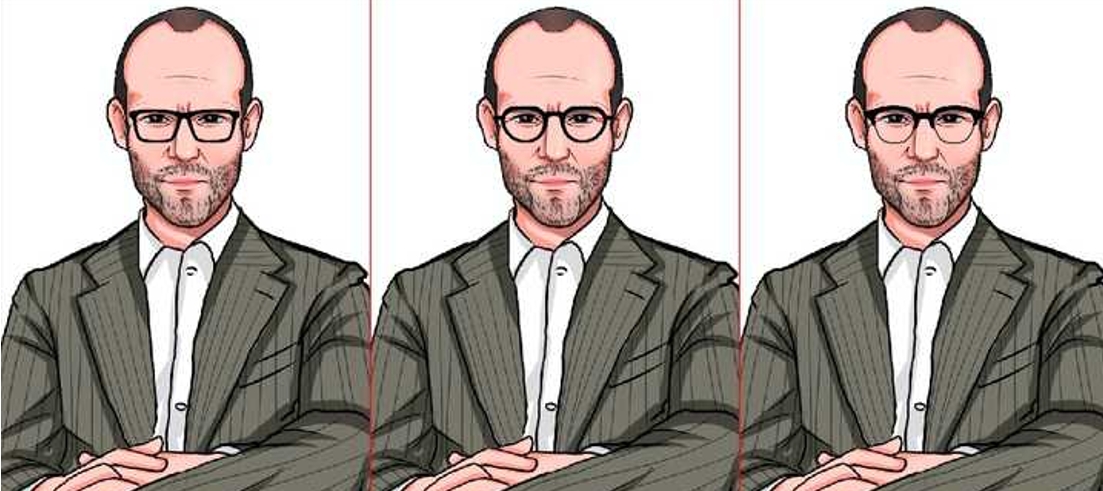
Wearing half-frame/eyebrow-frame glasses can raise the visual focus well, reconstruct the upper-lower proportion of the face, and can effectively reduce the proportion of the forehead (the right one in the picture below).
You can also use glasses with a strong styling sense to create a prominent style, and then weaken the existence of a relatively high hairline from a higher dimension (the middle one in the picture below).
The left one in the picture below clearly has the longest forehead, but it still looks much better than not wearing glasses.
B) Long Middle Face. It is recommended to wear full-frame glasses with a larger vertical height, which can occupy the space of the middle face well and make the proportion of the middle face more even.
C) Short Face. This is a very difficult design.
Don't use large frames, as they will take up too much space on the face and make the face look even shorter;
Eyebrow-shaped frames are a good choice. After re-dividing the upper-lower proportion of the face, it will be easier to make the face look longer;
The lines on the upper edge (sometimes including the lower edge) of the frame had better be slightly upturned to form an "unstable" layout, which will break the contour of the short face;
If you really don't know how to choose, choosing frameless glasses is less likely to go wrong.
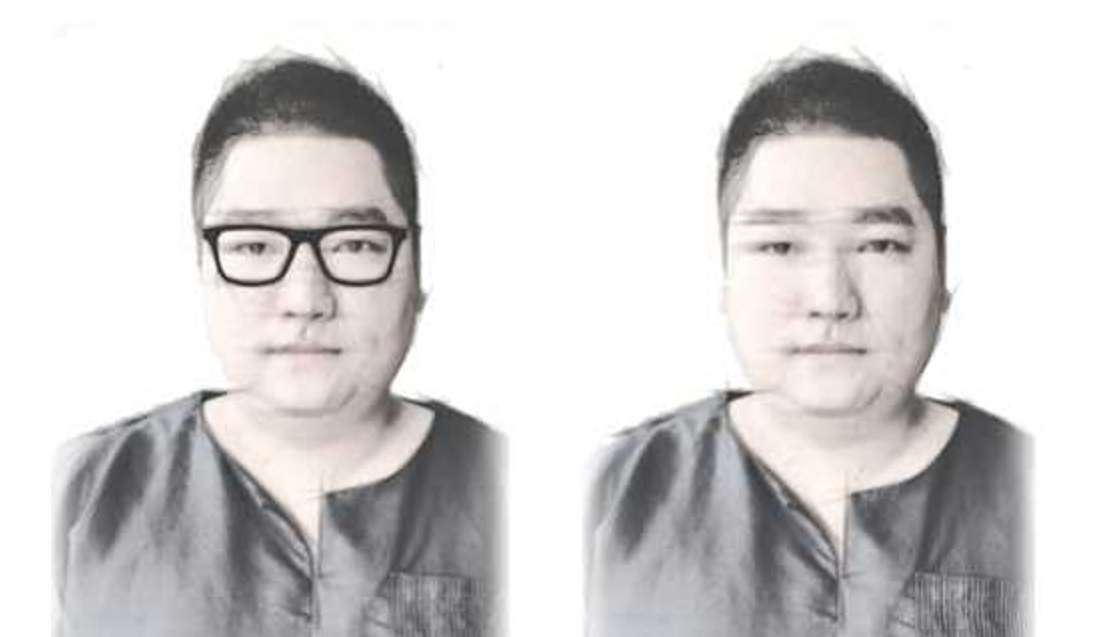
D) "Shen" Face (a face shape similar to the Chinese character "申"). The methods here are very useful. People with high cheekbones should pay attention.
The glasses should have long temples, shifting the widest part of the face to the temporal side;
The outer edge lines should be V-shaped and inwardly converging, and the trend of the lines had better be parallel to the tangent line of the side face, using the substitution effect of lines to redraw the facial lines;
It is recommended to choose thick-frame glasses, and the lower edge of the glasses should cover the high points on the front of your cheekbones;
When the above three points are met simultaneously, using partial occlusion + partial breaking + line extension + appropriate repetition = a significant substitution effect of lines.
E) Fat Face (upper narrow and lower wide).
You can choose larger square glasses to balance the visual weight and make the facial proportion more even;
The outer edge lines should be V-shaped and inwardly converging from top to bottom (see the picture), using the extension effect of lines to weaken the relatively wide cheeks;
The width of the temples must be wide enough, preferably greater than or equal to the widest part of your face, to shift the focus;
The styling of half-frame/eyebrow-frame glasses can re-divide the facial proportion and lengthen the face (another effect of a lengthened face is that it will look thinner);
Irregularly shaped glasses can also be considered appropriately.
F) Fat Face (a bit square). Besides choosing half-frame glasses, you can also consider round/elliptical glasses. Round glasses will give a strong style, which will make people pay less attention to the face shape.
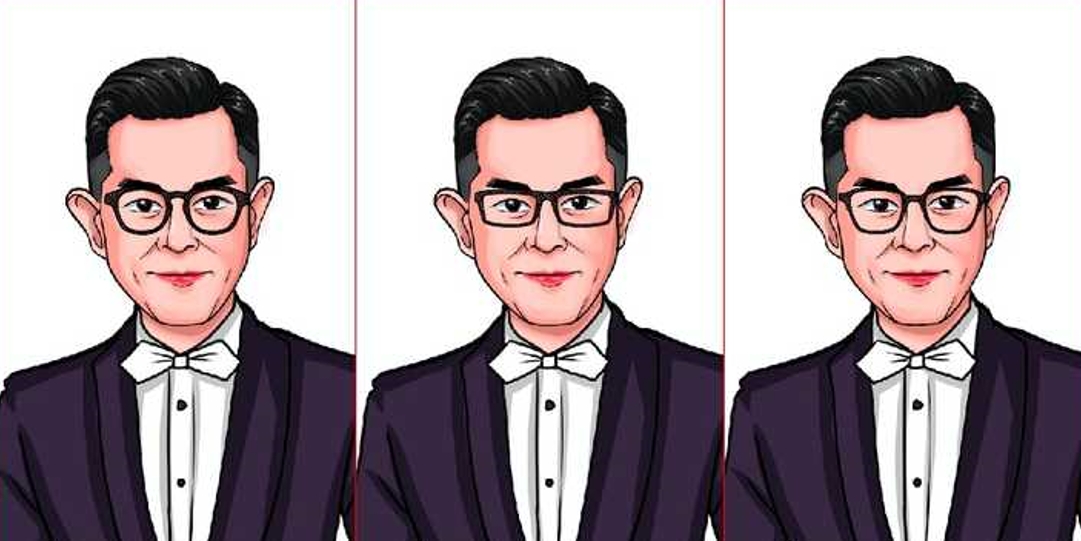
G) Square Face. The square face shape is a characteristic, not a defect (please ignore the current fashion trend). A square face will give people a sense of toughness and determination.
If you don't like the square face contour, you should avoid square frames, especially those with outer edges that are vertically downward. Compare the difference between the middle picture and the right picture. The middle picture looks much squarer because of the lines on the outer edge. Also, pay attention that the corners of the outer edge and the lower edge should not be too square. The effect of repetition will aggravate the feeling of a square face.
If you like the square face, you can strengthen it in a reverse operation, for example, like the middle picture.
H) Regarding the five modification methods for eyes, eyebrows, slimming, nose/bridge of the nose, and color, they are in the supplementary part at the end.
The following basic rules are easy to remember and practical:
Choose large glasses for a large face.
The pupil should be in the upper half of the lens. This is not only for good looks but also involves health issues.
The visual center of gravity of the glasses should be in the upper half of the face (on the golden section ratio).
Make the widest part of the face near the temporal side.
Half-frame glasses can make the face look longer and also have a slimming effect.
Irregular shapes can weaken the square face.
Dark-colored glasses can make the skin color look good.
Most importantly, consider health factors, such as inclination angles and lens-eye distances. I'll talk about them in the fifth part later.
If you think what I wrote is good, remember to subscribe to our website! So that you can enjoy the latest discount information.