Yesterday, a friend came to Glasses Magic, saying she wanted to get a new pair of glasses. My friend is a bit special as her eyesight is quite poor. One eye is nearly 900 degrees myopic, and the other is 800 degrees myopic, with both eyes having nearly 200 degrees of astigmatism.
She specifically instructed that she wanted to change her style this time and try to break through. She said she wanted to get those large round frames, the most popular ones nowadays, the metal large - round frames that are extremely popular in various videos, online stores, and live - broadcasts.
To make it easier for you to understand, I found a few pictures. You can take a look and you'll know. Many people around us are wearing this kind of frame now.
As shown in the picture below:
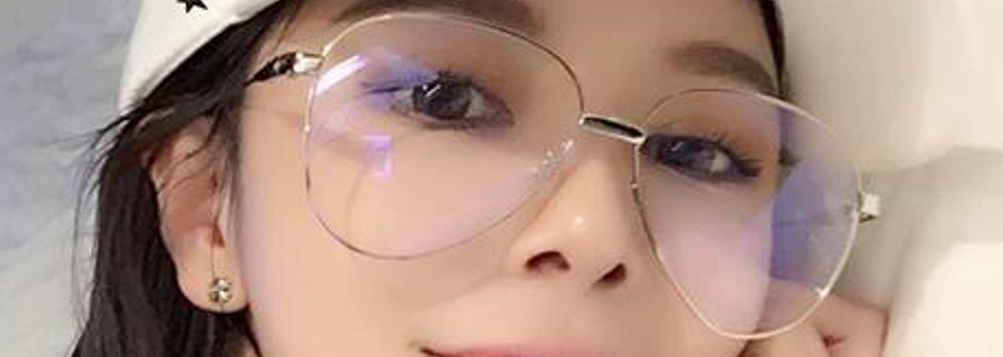
[Here, if there were pictures, it could be described like: The frame is large and round, with a metallic luster, showing a trendy and cute style.]
Isn't it cute? Many girls really like it!
However, I directly refused her. I told her that if she insisted on getting this kind of large - round frame, then don't come to me to fit the glasses. She could secretly go to other places or order online. And don't let me know after getting them, otherwise, I would feel very uncomfortable, just like a fitness coach can't stand seeing a trainee secretly eating KFC or McDonald's.
After this incident, I started thinking. Logically, these people with high myopia must have worn more than one pair of glasses. Some of them can even be regarded as semi - experts. They know exactly what to do first and what to do next when they sit in the optometry room. But why are there still so many friends with high myopia so indifferent to their situation and the importance of getting a suitable pair of glasses?
So, I really want to write an article about the precautions and common principles for fitting glasses for high myopia, hoping that more friends with high myopia can know how to choose glasses.
We are going to discuss the issue of fitting glasses for high myopia, and in contrast, there is moderate and low myopia. What is the fundamental difference between high myopia and moderate - low myopia?
The fundamental difference lies in the length of the eye axis.
For high myopia, the eyeball is elongated and relatively protrudes. The eye - axis length of high - myopia eyes is longer than that of moderate - low myopia eyes, and they look more protruding. That's why when many people with high myopia take off their glasses, their eyes seem very protruding. In fact, it's not because of wearing glasses. There is a misunderstanding among many people about this. The eye - axis of people with high myopia is elongated. To make an inappropriate analogy, it's as if there is an invisible pulling force stretching the eyeball.
Due to the structural change of the elongated eyeball, many complications will occur, which are the myopia - related complications we often talk about. These myopia complications are directly related to the length of the eye - axis. It's not that moderate - low myopia has no myopia complications. It's just that because the eye structure change of moderate - low myopia is minimal, and the eye - axis length is relatively normal, so the complications are relatively few. Because of the overly long eye - axis, high myopia has many complications.
For general moderate - low myopia, we just need to get a pair of glasses, which won't have a big impact on our lives and health. But for high myopia, we need to be vigilant about some of its complications. So, the key to myopia is to control its rapid progression and prevent it from developing into high myopia. Of course, myopia prevention and control is a very systematic and professional issue, which we won't discuss today.
The "pulling" of the overly long eyeball on the fundus leads to various complications. High myopia brings many potential risks of ophthalmic diseases due to the overly long eye - axis. According to previous research, if the myopia is above 400 degrees, the risk of retinal lesions is 5% higher than that of normal eyes. However, when the myopia is above 800 degrees, the risk of retinal lesions increases significantly to 40%.
Common complications of high myopia include retinal detachment (commonly known as retinal detachment), retinochoroidal atrophy, macular degeneration, macular hemorrhage, macular hole, and glaucoma. Visual changes include flash sensations, floaters, visual field defects, and progressive or sudden vision loss.
Precautions for Using Eyes with High Myopia
Are some people a bit scared after reading the above? A sense of fear arises spontaneously, constantly worrying about going blind? In fact, we need to know about these complications of high myopia to alert ourselves and make our best efforts to prevent them.
Although today we are talking about the principles and precautions for fitting glasses for high myopia, since the topic has touched on complications, let's also talk about what friends with high myopia should pay attention to in daily life, apart from wearing glasses reasonably and regularly.
First and foremost, it is to use eyes reasonably, especially for close - range eye use. Important things are said three times: Pay attention to close - range eye use! Pay attention to close - range eye use! Pay attention to close - range eye use!
When looking at close objects for a long time, you must shift your attention. Don't stare at the screen for several hours. You don't need to remind yourself deliberately. You just need to get up to drink a glass of water, go to the toilet, and take a few glances at the scenery outside.
You must develop this habit. Your eyes have a much higher potential risk of ophthalmic diseases than others, so don't imitate others who use their eyes closely for several hours continuously.
[Here, a more vivid description could be added, like: Imagine your eyes as a hard - working machine. If it keeps running at high - speed for a long time without a break, it will surely break down. Similarly, your eyes need short breaks during long - term close - range use.]

I recommend that friends with high myopia go to the hospital to check the fundus at least once a year or every two years, and regularly check changes in factors such as intra - ocular pressure, visual field, and eye - axis. If necessary, conduct some other eye examinations. Detecting lesions early helps prevent these complications and minimize their harm.
Of course, usually, you should also pay attention to some visual changes in your eyes. For example, sudden vision loss, seeing things as bent or distorted, an increase in flashes, and an increase in floating spots in front of the eyes. These visual changes are all reminders of some changes in the fundus. Never ignore them. Remember to go to the hospital for an examination or follow - up.
The last piece of advice is that friends with high myopia should not participate in some highly physical contact sports. Because during the movement, the eyeball is likely to be hit, causing retinal detachment and other fundus diseases. In addition to contact sports, some sports that increase intra - ocular pressure should also be avoided as much as possible, such as bungee jumping and roller - coaster - like entertainment activities.
How Should High - Myopia People Choose Glasses? What Precautions and Principles Should Be Noted?
In our usual fitting process, the fitting principle for moderate - low myopia is to use the minimum degree to achieve the best vision. For example, for a customer with normal visual function and no significant esophoria or exophoria, the fitting process is as follows:
-
300 - degree myopia, vision 0.8;
-
325 - degree myopia, vision 0.8;
-
350 - degree myopia, vision 0.9;
-
375 - degree myopia, vision 0.9;
-
400 - degree myopia, vision 1.0;
-
425 - degree myopia, vision 1.0;
-
450 - degree myopia, vision 0.9;
Through the above optometry process, we can see that the best vision of this friend is 1.0. No matter how many more degrees are added, the vision will not increase. And we can see that both 400 degrees and 425 degrees can achieve a vision of 1.0. So, we should choose the lower degree. Therefore, the prescription for this customer with the minimum degree and the best vision is 400 - degree myopia.
If the customer has no discomfort during the trial - wearing, we will give this prescription. However, for friends with high myopia, we need to be especially careful and make modifications according to the customer's adaptability. Why make modifications?
In principle, for customers with high myopia, we should also provide full correction, including astigmatism. But after fitting like this, we often find that customer satisfaction is not high. The reasons are as follows. High myopia is generally at least seven or eight hundred degrees, and some are over a thousand degrees. Their lenses are very thick, very heavy on the face, and the comfort level is extremely low.
Moreover, due to the heavy weight, the stability is very poor. We often see that their glasses always fall down, and they are constantly pushing up their glasses. This will cause instability in the vertex distance. Coupled with the high degree, this instability of the vertex distance will lead to a reduction in the size of the seen objects, making people feel that the vision is very unrealistic, and even giving a feeling of stepping into the void when looking at the ground.
The glasses falling down will also cause the optical center to move up and down. This movement will bring a strong sense of shaking, causing the customer to feel dizzy, headache, and even nausea.
The edges of high - myopia lenses are very thick. Some customers don't understand and insist on choosing semi - rimless or even rimless frames to assemble according to their own wishes. I've also encountered some customers who buy frames online according to the effect of models wearing them. In fact, these frames are very unsuitable for high - degree lenses.
Because the edges are thick and exposed, the cut - edge surface of the lens will refract and scatter light. When looking left and right through the lens, you will find serious chromatic dispersion, with colorful lights like a rainbow, which seriously interferes with normal vision and brings great discomfort.
Therefore, for people with high myopia, even super - high myopia (with a degree exceeding 1000 degrees), when choosing a frame, be extremely cautious. Do not choose rimless frames, be careful with semi - rimless frames, and it is best to choose full - rimmed frames.
For the choice of frames, in addition to recommending full - rimmed frames, the following issues should also be noted.
Each frame, like clothes, has a size. This size should match your eye parameters as closely as possible. The eye parameter here refers to the inter - pupillary distance (IPD), which is the straight - line distance between the centers of the two eyes. This is different for everyone. Some people have an IPD of 58mm, and some have 70mm.
The straight - line distance between the centers of the two lenses of the frame is called the frame center distance. The smaller the difference between the frame center distance and the IPD, the thinner the edge of the made - up lens will be, and the lighter the whole will be. This is an important point, write it down.
So, you know why at the beginning of the article, I strongly opposed choosing that kind of large frame. Because the frame center distance of that large frame is extremely large. Fitting high - myopia lenses with it is simply a disaster! It is extremely uncomfortable to wear, with obvious shaking, and it can cause dizziness and nausea.
[Here, a more vivid description of the discomfort can be added, like: It's like wearing a pair of constantly - shaking binoculars on your face, making it difficult to focus and causing discomfort all over the body.]
Also, the frame has a parameter called frame height. Friends with high myopia can choose the frame with the smallest frame height that they can accept in appearance when choosing a frame. The frame height should not be too high. Because the higher the frame height, the heavier the final product will be. The large - round frame mentioned at the beginning of the article will be twice as heavy as an ordinary frame! Now many people have got it backwards. Or perhaps due to the drive of profit, many merchants blindly promote ultra - thin lenses. If you choose such a large frame, you will definitely have to buy expensive so - called ultra - thin lenses.
I think this is putting the cart before the horse, and customers also spend a lot of unnecessary money. The first decisive factor in the final weight of a pair of glasses is not the ultra - thin lens, but choosing a frame that matches one's eye parameters. Once the frame is chosen wrongly, even if you choose the thinnest lens in the world, it's useless. So, I especially remind friends with high myopia of the importance of choosing a suitable frame. Not only should the parameters match, but also after wearing it, it must be ensured that the frame is not easy to fall off and loosen. For friends with high myopia, an unstable frame means more shaking and a reduction in the size of the seen objects.
Repeat three times: High - myopia people should not choose large - round frames! High - myopia people should not choose large - round frames! High - myopia people should not choose large - round frames!
Adaptability Issues and Near - Vision Solutions for High Myopia
In principle, the degree of glasses for high myopia should be fully corrected. However, we need to pay special attention to the adaptability of people with high myopia. Especially when there is a big difference between the new glasses' degree and the old ones, or when it's the first time to wear glasses.
Because when people with high myopia wear new glasses, the seen objects are significantly reduced in size, and the glasses are very heavy, so it's difficult for them to tolerate fully - corrected lenses. In response to this situation, we can correct step - by - step. The first - time degree can be 1/3 less than the measured result. After they adapt to it for a while, gradually increase it to the maximum degree and best vision they can tolerate.
The 1/3 degree reduction mentioned above is just an empirical rule. In some special cases, we need to find the best balance between "comfort" and "best vision" based on various factors such as the customer's age, adaptability, and near - vision needs. This requires us to communicate carefully with the customer and fully understand their eye - using environment and glasses - fitting needs.
In addition to distance vision, we also need to pay special attention to the near - vision needs of friends with high myopia. Due to the elongation of the eye - axis and myopia of the eyes, when they look at close objects, the accommodation they use is relatively low. Long - term non - use or less use of accommodation leads to a decline in their accommodation ability.
This decline is caused by high myopia and has no absolute relation with age. So, we are very likely to neglect it. Because we all think that only older people have difficulty seeing close objects and have poor accommodation. In fact, many young friends with high myopia also have very poor accommodation. Therefore, near - vision examination is very necessary.
When fitting glasses, we must also consider their near - vision problems. According to the time they spend looking at close objects and their work nature, if necessary, reduce the degree a little, under - correct a bit, starting from their needs. Of course, for teenagers and children, considerations should be based on stabilizing the degree, which is a bit different.
For the optometry of high myopia, in addition to testing distance vision, it is necessary to test near - vision as well. When wearing the trial frame, it is best to look at close objects more and feel the difference.
I especially recommend that friends with high myopia, if possible, get two pairs of glasses, one for distance and one for near. Get a separate pair for use at home or for near - range office work. This is very helpful for relieving eye tension and slowing down the increase in degree. However, for friends with abnormal visual function, especially those with excessive exophoria, this is not recommended, otherwise, it may have the opposite effect. Don't reduce the degree on your own. Be sure to have an optometry test.
Friends with a degree not exceeding 1000 degrees can wear anti - fatigue lenses that specifically help with near - vision accommodation, and can also add the function of blue - light protection. In this way, when working at close range, both relaxation and protection can be achieved. For super - high - myopia friends, the effect of all progressive lenses is not very good. So, it is still recommended to get two pairs of glasses, one for distance and one for near.
There are also some small - probability cases. Some friends with high myopia, no matter how suitable the frame is chosen and how much the myopia degree is under - corrected, still can't adapt to wearing glasses. In this case, rigid gas - permeable contact lenses (RGP) can be considered.
Rigid gas - permeable contact lenses are closely attached to the cornea. There is no such thing as vertex distance, so the influence of aberration and magnification is greatly reduced, and relatively full correction can be achieved. The imaging quality is also the closest to that of the naked eye, and there is no adaptability problem. The vision correction effect is also better. However, the foreign - body sensation when wearing them and the potential infection risk are also their drawbacks. Special care and attention are needed. It can be used as a second choice for those who can't adapt to frame glasses. Similarly, soft contact lenses can also be considered.
Finally, I hope that friends with high myopia pay attention to its complications, use their eyes reasonably in daily life, not use their eyes closely for a long time with high concentration, and learn to be relaxed and combine work with rest.
The above are all summaries and experiences from my daily work. There may be some deficiencies. If you have any supplements or corrections, you are welcome to send me a private message.
If you think what I wrote is good, remember to subscribe to our website! So that you can enjoy the latest discount information.